


A MODERN EXPRESSION OF A TRADITIONAL VOICE
The Whitney Vagabond ‘Grande Bouche’ draws from the Selmer–Maccaferri tradition, carrying that voice into a more controlled, modern build.
Structured back and sides, an authentic pliage soundboard, and a longer 670mm scale work together to produce strong projection, quick attack, and a tone that remains balanced across the register.
Familiar in character — more refined in its response.
MODÈLE VAGABOND
The Modèle Vagabond reflects my interpretation of the Selmer–Maccaferri ‘Grande Bouche’ — offered in two distinct configurations, each with its own feel and response.
The 670mm long scale, paired with a 14-fret neck joint, provides enhanced access and projection — well suited to players moving between rhythm and lead. It retains the warmth of the traditional 12-fret design, with a more immediate, articulate response.
Alternatively, the 640mm short scale with a 12-fret connection offers reduced string tension and a lighter feel under the hand — a configuration some players naturally prefer.
The long scale Vagabond, built with a five-brace system to manage increased tension, delivers the focused “punch” associated with oval-hole guitars, while maintaining balance through the mid and low range.
A large D-shaped soundhole supports projection and air movement,
giving the instrument presence without sacrificing control. Across both configurations, the Vagabond remains responsive — resolving differently depending on the player.
Starting at: $7,500 CAD
Excludes shipping, applicable taxes and insurance.

Every note sings with clarity, and the responsiveness makes it a dream to play.
Whether you're strumming chords or diving into fast, intricate leads,
the instrument remains effortless and controlled.
DAVID JARRETT - PENNSYLVANIA, USA
SPECS & DIMENSIONS


Adhesives | Aliphatic resin (Titebond Original) |
Back & Sides | Select tonewoods — Indian Rosewood, Flamed Walnut, Pau Ferro, Flamed Maple |
Binding | Ebony, Maple, or Walnut |
Body Depth | 90.7 mm (neck) → 101.1 mm (tail) |
Body Length | 470 mm (18.5″) |
Bracing | Quarter-sawn Spruce 5-parallel bracing, hand-voiced |
Bridge | Rosewood or Ebonized Rosewood, hand-shaped |
Case | Hardshell case included (upgrade options available) |
End Graft | Inlaid strip with matching purfling |
Fingerboard | Ebony |
Finish | Polyurethane or French Polish; nitrocellulose available by request |
Frets | 25 medium nickel-silver frets (18%) |
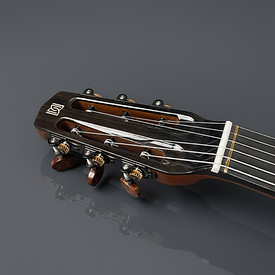
Headstock | Slotted headstock with ebony veneer and engraved MW logo |
Liners | Solid |
Lower Bout | 400 mm (15.75″) |
Neck | Honduran Mahogany (standard); Maple, Walnut, or African Mahogany available |
Neck & Reinforcement | Carbon fibre reinforcement |
Neck Joint | 12-fret or 14-fret configuration |
Neck Profile | Traditional flat “D” or modern “C” |
Nut | Bone |
Nut Width | 45 mm |
Overall Length | 1009.5 mm (39.75″) |
Rosette | Veneer or solid, with custom motif options |
Scale Length | 640 mm or 670 mm |
Soundboard | Select Spruce or Cedar (voiced per build) |
Strings | Savarez Argentine 11–46 |
Tailpiece | Dell’Arte DR Selmer-style |
Truss Rod | Dual-action |
Tuners | Schaller GrandTune open-gear (various options available) |
Upper Bout | 289.5 mm (11.38″) |
Waist | 256.6 mm (10.13″) |
Width at Body Joint | 57 mm |
SOUNDBOARD OPTIONS
The soundboard defines the instrument’s response.
Sitka spruce remains the standard — valued for its strength, headroom, and balanced tonal range.
Alternative options, including bearclaw spruce, torrefied spruce, and sinker redwood, offer different characteristics in feel, response, and visual expression.
Selection is made as part of the build — based on the player and the direction of the instrument.

Sitka Spruce · Standard
BACK & SIDE OPTIONS
The back and sides influence how the instrument responds and reflects energy.
Indian rosewood remains a standard — valued for its depth, clarity, and strong low-end presence.
Alternatives such as flamed walnut, pau ferro, and flamed maple offer different balances of warmth, brightness, and projection, along with distinct visual character.
Selection is made as part of the build — based on the player and the direction of the instrument.
%20-%20Back%20and%20Side%20Wood.png)
Pau Ferro · Clarity
TAILPIECE OPTIONS
Each Whitney guitar is fitted with a vintage-style Selmer tailpiece, faithful to the original 1930s design.
I use the Dell’Arte DR tailpiece — a well-proven interpretation known for its durability, stability, and tonal contribution. Its heavier brass construction adds a touch of density at the string anchor point, subtly enhancing sustain and overall response.
A traditional detail, executed with purpose.

Dell'Arte DR · Brass Tailpiece
TUNING MACHINE OPTIONS
Each Whitney guitar is fitted with Schaller GrandTune machines — an open-gear design that pairs vintage character with precise, reliable tuning.
Deliberate in feel, precise in adjustment and built to last, they offer the stability and control expected of a modern instrument, with an aesthetic that remains true to the Selmer tradition.
A range of finishes and button options allows for subtle personalization.

Schaller GrandTune · Black / Snakewood
NECK OPTIONS
Neck wood plays a subtle but important role in both feel and response.
I primarily work with Honduran mahogany for its stability, balance, and familiar midrange character. Select alternatives are available, offering slight variations in weight, stiffness, and tonal emphasis.
Each neck is shaped, reinforced, and finished with playability and long-term stability in mind — ensuring a consistent feel across the instrument.

Honduran Mahogany
FINISH OPTIONS
Polyurethane and French polish offer two distinct approaches to finishing.
Polyurethane provides a durable, protective finish with excellent clarity — a modern, reliable option that preserves definition while standing up to regular use.
French polish, applied by hand using traditional shellac, creates an exceptionally thin finish that allows the instrument to respond with greater immediacy and warmth, though with less resistance to wear.
One prioritizes resilience and clarity. The other, sensitivity and nuance.

Polyurethane · High Gloss
PICKUP OPTIONS
A range of pickup systems is available, each chosen for its ability to translate the character of the instrument.
Options from makers such as Big Tone, Yves Guen, Krivo, and Miller offer distinct approaches — from warm, traditional voicing to more focused, high-output designs suited to modern amplification.
Each offers a different way of carrying the instrument’s voice forward.

Big Tone · Gypsy Pickup
Crafted and voiced in my Okanagan workshop, I build steel-string acoustic and gypsy jazz guitars—each shaped, voiced, and finished by hand.
INSTRUMENTS
Acoustic Guitars
Gypsy Jazz Guitars
COMISSION
RESOURCES
CONTACT
© 2026. WHITNEY GUITARS | HANDMADE IN SUMMERLAND, BRITISH COLUMBIA